
The Relational Leadership Method by collabbway
Leadership doesn't break in the big moments.
It breaks in the small ones.
Conflict
Miscommunication
Change Fatigue
Trust Repair
Burnout
Leadership is built in the small moments.
Most leadership development teaches leaders what to know. The Relational Leadership Method (RLM) teaches them how to do it: in the conversations they've been avoiding, the feedback that never quite lands, the 1:1 that drifts.
The RLM is built on two stances (curiosity and naming), four foundational self-leadership practices, and 26 relational micro-skills managers can use in the moments that actually shape their teams. Delivered through EMBBED+, our embedded change methodology, RLM doesn't sit on a shelf after the workshop. It becomes how your managers lead and influence, and how your organisation retains the people you can't afford to lose.
Grounded in emotional intelligence, social work practice, neuroscience, adult learning principles, and organisational/behavioural psychology, RLM closes the gap between leadership knowledge and leadership action. It is practical, evidence-informed and built for the complexity of modern Australian workplaces.
The method is organised around six Leadership Lenses + a Self-Leadership Foundational module — each representing a critical area of leadership capability that leaders develop through deliberate, consistent practice.
1 Core Principle: connection before correction.
2 Stances: curiosity and naming.
30 Relational Behavioural Skills — specific, teachable and immediately usable.
1 Self-Leadership foundation module and 6 Leadership Lenses.


The Six Leadership Lenses of the RLM
A practical, evidence-informed approach for modern workplaces.
1 - Reading Context
Effective leadership begins with understanding people — not just what they deliver, but what is driving them. This lens helps leaders read beneath the surface of behaviour, build trust in everyday moments and create the safety people need to do their best work.


2 - Addressing Behaviour & Expectations
Clear expectations and honest conversations are the foundation of a high-performing team. This lens equips leaders to address behaviour early, set standards with clarity and hold accountability — without losing the relationship in the process.
The quality of a leader's conversations is the quality of their leadership. This lens develops the skills to start difficult conversations directly, stay present when they get uncomfortable, and hold connection and clarity at the same time.
3 - Leading Conversations


4 - Leading without Carrying
Many leaders over-function — solving problems that belong to others, carrying the team's emotional load, stepping in when they should step back. This lens builds the skills to shift ownership, grow independent thinking and build genuine accountability across the team.


5 - Decision-Making Under Pressure
Leadership is tested most when pressure is highest. This lens strengthens a leader's ability to regulate before reacting, think clearly in the noise and hold their standards even when they are being tested. When leaders are steady, teams feel safer.
6 - Leading Change
Change is both emotional and practical. This lens equips leaders to read how people are actually responding to change, communicate with honesty even when not everything is known, and embed new ways of working without overwhelming the people they lead.
Conflict
Miscommunication
Change Fatigue
Trust Repair
Burnout
Why RLM Works
It blends research-backed insight with real, practical action.
Managers learn how to:
Understand employee behaviour and motivation.
Read what’s really going on in their team.
Reduce friction and emotional load.
Lead employee conversations that stay honest and calm.
Make grounded decisions under pressure.
Support people through change and uncertainty.
Build habits and workplace practices that shift culture over time.
RLM is evidence-informed, yet delivered in plain, human language that makes sense in real workplaces.


What changes for your leaders
They have the 1:1 they've been putting off, and it actually moves something
They give feedback that lands, instead of feedback that drifts.
They hold the line under pressure without hardening or shutting down.
They name what's going on in the team before it becomes an HR issue.
They lead change without absorbing the cost in their own nervous system.
They build the kind of team culture that retains the people you can't afford to lose.
This is leadership built from the inside out — behaviour, emotion, clarity and action.
What is this for
New and emerging managers learning how to lead, not just manage.
Experienced managers carrying heavy relational load — the ones their teams rely on.
Teams navigating conflict, change, or quiet disengagement.
Organisations that want capability built into how their managers lead — not delivered in a workshop and forgotten.
If your people are avoiding conversations, stuck in reactivity, or struggling with team dynamics, RLM equips them with the skills to shift unhelpful workplace behaviours.
How RLM gets built into your workplace
Most leadership programs end when the workshop ends. The slides get filed. The language fades. Six months on, managers are back to the patterns they came in with.
RLM is delivered differently — through EMBBED+, our embedded change methodology.
EMBBED+ is a six-stage process for building capability into how your organisation actually operates. Not a program or a set training calendar. A method for embedding new manager practice into the rhythms, conversations, and systems your people already use.
The six stages:
ESTABLISH: align leadership, set the capability case, define what success looks like.
MAP: surface the current state of manager practice, culture, and capability gaps.
BRING: introduce RLM through structured learning that respects the workplace landspace and time commitments.
BUILD: practice, peer coaching, and reinforcement in the moments that matter.
EMBED: integrate RLM language and skills into manager rhythms, 1:1s, and team practice.
Deepen: sustain capability through ongoing reflection, measurement, and leader-led.
EMBBED+ is grounded in established change research — Kotter, ADKAR, Implementation Science and the work of Edmondson, Schein, Senge, and Bandura on how adults actually change practice at work.
The result: capability that doesn't evaporate. Managers who lead differently three, six, and twelve months on. An organisation that builds leaders from within rather than buying them from outside.
EMBBED+ is the reason RLM doesn't sit on a shelf.



RLM Origin
When I first set out to build collabbWAY, I didn't have a neat angle. I was trying to understand something I'd seen for years — why some leaders could hold their teams together under pressure, and why others, equally capable, found leadership becoming heavier than it should be.
What became clear was this: it wasn't capability. It wasn't intent. It was how relationships were being held inside the work.
My background in social work shaped this thinking. I learnt how to understand people in context. How to listen beyond what's being said. How to build trust in moments that matter. Those skills changed how work actually moved.
That's where the RLM comes from.
Brooke Baxter - collabbWAY based in Geelong.
The Evidence Behind the RLM
The RLM draws on modern leadership research, organisational and behavioural psychology, behaviour change science, emotional intelligence, neuroscience, workplace communication theory, social work practice, adult learning, and the change and transition models used in complex systems.
We take the evidence, strip out the jargon, and turn it into simple relational behaviour skills and practical ways of working so leaders can use it tomorrow. That’s what makes RLM both credible and deeply practical — grounded in research, but delivered in a way that makes sense in real workplaces.
The framework is explicitly behaviour-driven rather than concept-driven. Where leadership research identifies what effective leaders do, the RLM asks how they do it — what the observable behaviour looks like, what it sounds like in a real conversation, and what the leader needs to regulate internally for that behaviour to be available under pressure.
The result is a framework that is evidence-informed in its foundations and leader-designed in its delivery. The research tells us what works. The RLM tells leaders how to do it tomorrow.

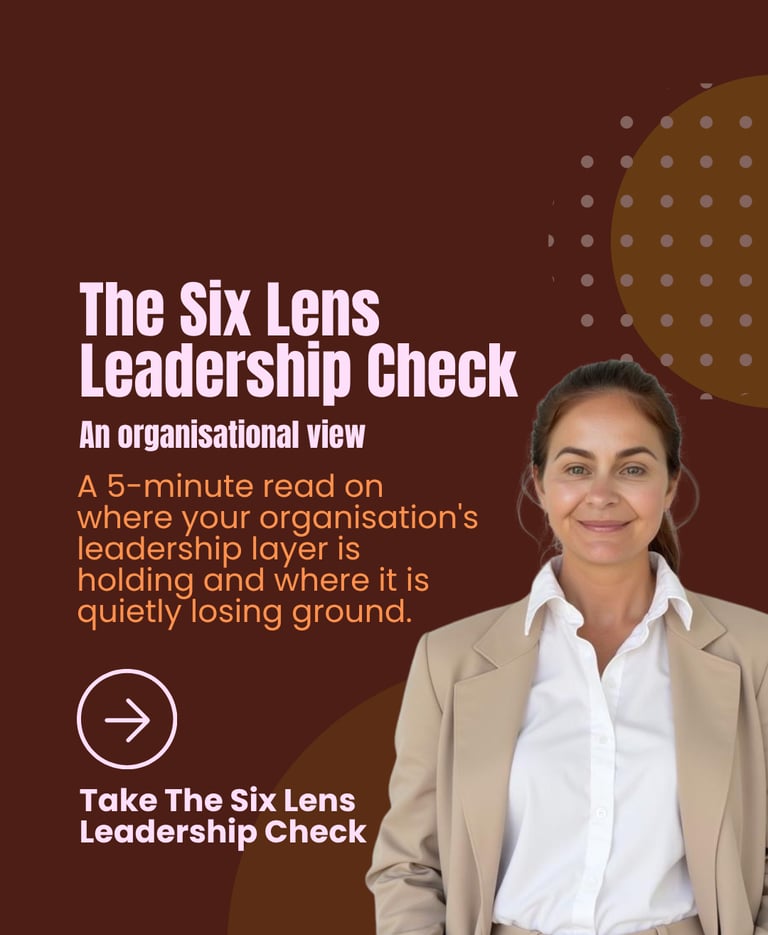
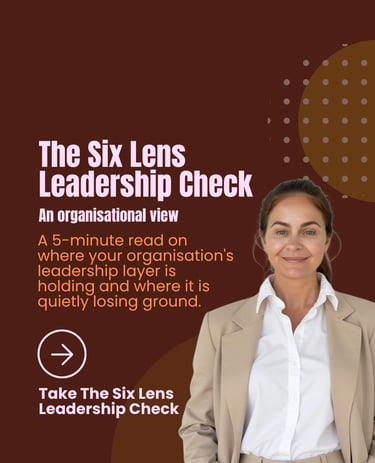
The Six Lens Leadership Check
Ready for an honest
read on your leadership layer?
The check maps your leadership layer across six areas drawn from the Relational Leadership Method (RLM) developed by Brooke Baxter, Founder of collabbWAY.
Each one is a domain where relational leadership either holds or quietly breaks down in real organisations.
Conflict
Miscommunication
Change Fatigue
Trust Repair
Burnout

The Manager Pain Points RLM Responds To
Managers feel emotionally underprepared
The modern workplace is full of intensity — conflict, stress, uncertainty, role changes, and exhausted teams.
Managers have to be steady, compassionate and clear, yet few have been taught how to regulate their own responses.
Pain point: “I’m expected to stay calm under pressure, but no one taught me how.”
RLM directly trains emotional regulation and clear thinking.
Difficult conversations are being avoided
Managers don’t struggle because they don’t understand what leadership is.
They struggle because no one ever taught them how to lead in real moments — the micro-skills that help them regulate, communicate, set boundaries, shift behaviour, and shape culture under pressure.
The RLM closes that gap by turning big leadership ideas into small, practical micro-skills leaders can use every day.
Managers avoid hard conversations because they fear conflict, emotional fallout or making things worse.
Pain point: “I know the conversation needs to happen, I just don’t know how to have it safely or clearly.”
RLM teaches the micro-skills of courage, clarity and relational honesty.
Managers try to shift performance, attitude or mindset, but they hit resistance.
Pain point: “I’ve said it ten times and nothing is changing.”
RLM gives leaders practical tools for readiness, momentum and shared ownership.
Behaviour change feels like pushing people uphill
Managers struggle to read the work situation and culture
Managers often personalise behaviour or misread the emotional context.
Pain point: “I take things personally or I can’t figure out why someone is acting this way.”
RLM gives them the relational insight and behavioural understanding needed to lead confidently.
Culture problems grow because managers act too late
Managers don’t know when or how to intervene early, so minor issues become big ones.
Pain point: “I see things going wrong, but I’m not sure when to step in or how.”
RLM teaches early intervention, small signals and micro-movements that shift culture.
Culture problems grow because managers act too late
Managers try to support everyone else while neglecting their own energy and boundaries.
Pain point: “I'm exhausted. I want to lead well but I’m running on empty.”
RLM builds the micro-skills of self-leadership — boundaries, reflection, values alignment.
Ready to close the gap
between knowing and doing?
Find out how the Relational Leadership Method can build leadership capability that will transform your team, your culture, and your everyday work moments.
© 2025 collabbWAY. All rights reserved.


Website by collabbWAY
Based in Geelong