
ARCA+: Bringing Reflection and Development Back to Social Work Supervision
This blog explores how traditional social work supervision, which can be dominated by compliance and task-checking, can be transformed into a space for reflection, growth, and capability building. Drawing on research and the ARCA+ Professional 1:1 Framework (collabbWAY, 2025), it demonstrates how supervision can evolve beyond oversight to become a powerful engine for developing individuals, strengthening culture, and sustaining effective organisations.
ARCA+ PROFESSIONAL 1:1
Brooke Baxter | collabbWAY
9/29/20253 min read
ARCA+: Bringing Reflection and Development Back to Social Work Supervision
Several years ago, I was leading a reflective practice workshop with a group of social work practitioners. One participant summed it up perfectly: “Supervision has become about task updates. We rarely get to pause and reflect on the things that matter.”
It was a truth. Traditional social work supervision was always meant to carry a reflective, developmental lens. However, the growing pressures on community services, including compliance requirements, legislative reporting, and the need to meet external standards, have led many supervision sessions to adopt a compliance-first model, where cases are reviewed, documentation is checked, and boxes are ticked.
Those practices still matter. Safeguarding quality and accountability will always be an essential part of the role and the delivery of community services, and I am not suggesting this change. However, if that is all supervision is to our social work practitioners, we risk losing the very heart of professional development.
Supervision was never meant to be just about oversight. At its best, it is a space where reflection, growth, and accountability come together. A place where practitioners process the emotional demands of frontline work, deepen their skills, and strengthen their decision-making.
However, in many organisations, supervision has not kept pace with the complexity and relational demands of today’s work, which is why the ARCA+ Professional 1:1 Framework (collabbWAY, 2025) was developed to bring supervision into the modern era.
The Evidence: Why Supervision Needs to Evolve
Supervision has long been recognised as a cornerstone of effective practice. However, research shows that when it drifts into compliance or task-only territory, it loses much of its power:
Reflective supervision builds resilience. Ruch (2005) and Bogo (2010) highlight that when practitioners have a structured space to reflect, they develop stronger ethical decision-making and emotional capacity to manage complex cases.
Psychological safety drives learning. Edmondson (1999) demonstrated that environments where people feel safe to speak up and admit uncertainty led to better outcomes and innovation.
Capability building requires support and stretch. Hawkins (2012) and Grant (2017) found that supervision grounded in coaching — balancing challenge with encouragement can result in deeper skill growth than directive oversight alone.
Integrated supervision improves quality. Morrison (2005) described effective supervision as comprising three interrelated functions: support, development, and accountability. When one is missing, the others weaken.
The evidence is clear: supervision that only manages risk and compliance falls short of its objectives. In modern organisations, supervision needs to be a growth vehicle, building the capability, wellbeing, and alignment of employees as much as meeting requirements.
The Teaching Moment: The ARCA+ Reset
The ARCA+ Professional 1:1 Framework offers a way forward. It is designed to rebalance supervision so that it honours accountability while making space for reflection and development.
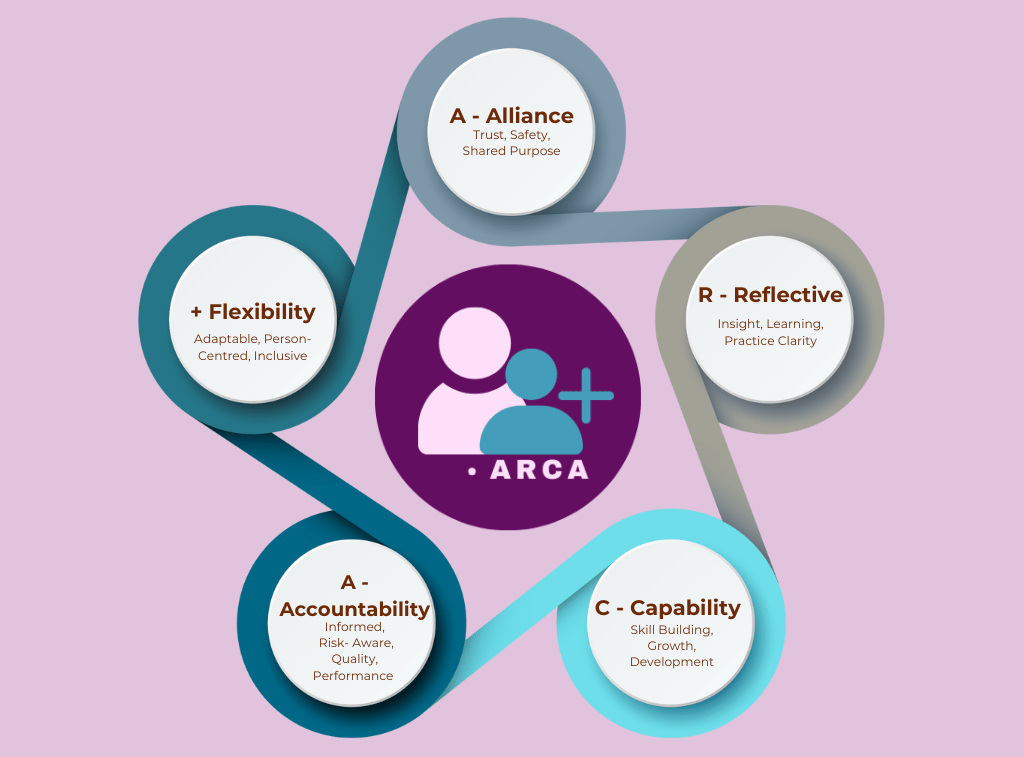
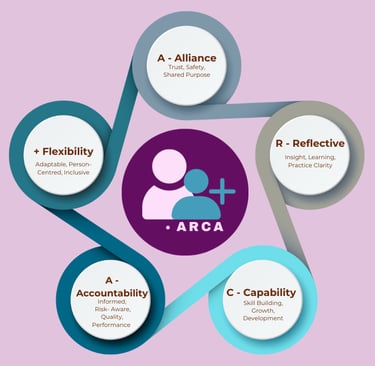
It is built around five relational pillars and one essential ingredient: a developmental mindset.
Alliance: Building trust, psychological safety, and shared purpose.
Reflection: Making space for deeper insight, meaning-making, and ethical awareness.
Capability: Stretching skills, strengthening practice, and growing confidence.
Accountability: Keeping supervision anchored to organisational priorities and quality standards.
+ Flexibility: Adapt to people’s needs, learning styles, and context.
What does this look like in practice?
A supervision session begins not with files, but with a wellbeing and capacity check-in.
Leaders and practitioners use a pre-session planner to identify reflection and capability goals, as well as task updates.
Conversations are structured with coaching-style prompts, encouraging practitioners to reflect and explore, not just report.
Accountability remains central; however, it is balanced with reflection and capability building, so growth is not sacrificed for compliance.
The impact is significant. One team that adopted ARCA+ described it like this:
“Supervision stopped being something staff endured. It became the place they felt safe, supported, and stretched.”
Final Reflection: Supervision for the Modern Era
Social work supervision is too important to be reduced to heavy compliance. Practitioners need more than oversight; they need safe, structured spaces to reflect, learn, and grow.
By reframing supervision through the lens of Alliance, Reflection, Capability, Accountability, and Flexibility, ARCA+ offers a model that is both rigorous and people-centred. It ensures organisations meet their quality requirements but also honours the deeper purpose of supervision: to grow and sustain the people who deliver the work.
Because effective organisations do not just manage risk, they develop their people to deliver high-quality service; furthermore, when supervision becomes a growth engine rather than a checkbox, everyone — practitioners, organisations, and communities benefits.
References
collabbWAY. (2025). ARCA+ Professional 1:1 Framework. collabbWAY Leadership Resources.
Edmondson, A. C. (1999). Psychological safety and learning behaviour in work teams. Administrative Science Quarterly, 44(2), 350–383.
Ruch, G. (2005). Reflective practice in contemporary child-care social work: The role of containment. British Journal of Social Work, 35(4), 521–535.
Bogo, M. (2010). Achieving competence in social work through field education. University of Toronto Press.
Hawkins, P. (2012). Creating a coaching culture. McGraw Hill.
Grant, A. M. (2017). The third ‘generation’ of workplace coaching: Creating a culture of engagement and productivity. Coaching: An International Journal of Theory, Research and Practice, 10(1), 37–53.
Morrison, T. (2005). Staff supervision in social care: Making a real difference for staff and service users. Pavilion Publishing.
© 2025 collabbWAY. All rights reserved.


Website by collabbWAY
Based in Geelong