A Simple Circuit Breaker for Middle Managers: The One Anchor Task
Middle managers are carrying more than ever; constant pivoting, competing priorities, and the human load of supporting teams in the workplace. It’s no surprise that clarity can slip and reactivity takes over. This blog shares a simple five-step circuit breaker, The One Anchor Task, to help you reset, refocus, and steady your leadership when the pressure is high. A practical, people-centred tool you can use on even the busiest days. If you want a moment of clarity in the rush, this one’s for you.
LEADERSHIP DEVELOPMENT
Brooke Baxter | collabbWAY
10/30/20254 min read
A Simple Circuit Breaker for Middle Managers: The One Anchor Task
Recently, I was speaking with a very experienced Manager, with whom I have been working for over 20 years, and she provided me with positive feedback on some of the relational leadership messages I had been sharing. But she said, 'Brooke, I believe in your messages and I want to be one of those managers, but I’m moving from one fire to the next, and by lunchtime I don’t even know what I’ve actually achieved.’
I looked at her and knew exactly what she was talking about. I have been that manager, a middle-level manager, carrying more than most people realise and moving from one thing to the next, doing, not thinking.
You’re somewhat across team wellbeing, operational priorities, daily decisions, shifting expectations, and change that keeps picking up speed. The load is heavy, and the pace is relentless. When things move this fast, the natural human response is reactivity.
That’s when you start to lose your way and focus. Your attention fragments and your brain jumps between competing demands; even simple decisions start to feel harder than they should.
Just in case this story is resonating with you, it’s not a capability problem.
It’s a cognitive load problem, and it happens to even the most experienced leaders.
Over the past few years, I’ve coached numerous middle managers through this, and this one tool consistently makes a difference on the days when everything feels urgent and nothing feels doable.
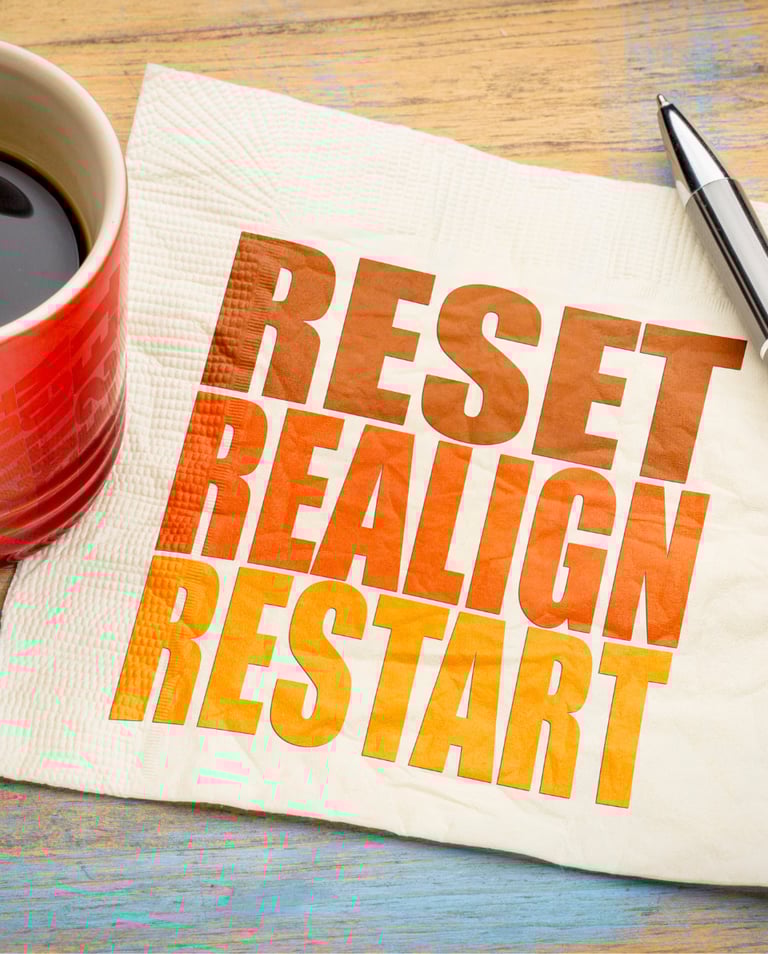
It’s called The One Anchor Task: a small circuit breaker that helps you reset, ground yourself, and step back into intentional leadership, even in the midst of a rush and chaos. Here’s how it works.
The One Anchor Task: A 5-Step Reset for Busy Managers
1. Stop for 60 seconds
Pause, and I mean, genuinely pause. Sit, stand, breathe. Whatever it takes to help your nervous system settle enough for your brain to think again, not just react.
2. Write down the top 3 things pulling at you
Not the complete to-do list and everything you're responsible for.
Just the three loudest demands that are eating your mental space.
This step alone immediately reduces overwhelm. Your brain can’t sort chaos, but it can sort three things.
3. Choose your Anchor Task
Look at your list and ask: ‘What one thing, if I did it now, would stabilise the rest of my day?’
That’s your Anchor. It might be:
a call you’ve been avoiding
a quick reset with a team member
finishing a document
setting expectations for the afternoon
addressing a minor issue that’s becoming a big distraction.
This step shifts you from scattered to centred.
4. Do it for 10 minutes
Ten minutes is the activation point. It gets you moving, thinking, and reclaiming momentum. Often, once you start working on your task in a focused manner, you’ll continue. Even if you don’t, ten minutes is enough to reset your headspace.
5. Reassess and reset
Now refocus and start the work again. What felt overwhelming usually feels clearer.
Your energy is steadier. Your decision-making sharpens, and you’re back in the driver’s seat, not the passenger seat of your own day.
Why This Works (The Behaviour Science Behind It)
The One Anchor Task is simple, but it’s not random. It’s grounded in cognitive and behavioural principles that help leaders move from overload to clarity. Here’s why it works:
• It reduces cognitive load. When your brain is overwhelmed, it shuts down higher-order thinking. Narrowing your focus to three things creates mental space.
• It interrupts the stress loop by stopping for 60 seconds, which helps your nervous system settle, allowing you to think with more clarity and less urgency.
• It activates behavioural momentum by starting one meaningful task, signalling to your brain: ‘We’re back in control.’ Small activation leads to bigger progress.
• It builds leadership presence and intentionality, not speed, which is what shapes how people experience you. A grounded leader creates grounded teams.
Why Middle Managers Need Tools Like This
Because you’re the connection point, the translator, the stabiliser, the sense-maker, and you’re managing competing priorities while supporting people through uncertainty and, often, doing it without the reflective space senior leaders have access to.
A tool like The One Anchor Task gives you a moment to breathe, recalibrate, and lead with clarity instead of reactivity.
It’s not just a productivity technique. It’s a leadership tool. A wellbeing tool. A circuit breaker for the load you carry.
Final Thought
If you’ve felt stretched, scattered, or constantly pivoting, you’re not alone, and you’re not doing anything wrong. It’s the load and the pressure, not the leader. The One Anchor Task helps you step back into yourself, even on the busiest days. Because clarity is rarely found by doing more, it’s found by pausing long enough to see what matters most.
If you’re a middle manager wanting more practical tools like this, you can also explore:
collabbWAY’s R3 = Insight Reflection Model
ARCA+ Professional 1:1 Framework
Monthly micro-learning drops for leaders by collabbWAY.
And if you try this tool today, I’d genuinely love to hear how it goes.
References
Boyatzis, R. E., & McKee, A. (2005). Resonant leadership: Renewing yourself and connecting with others through mindfulness, hope, and compassion. Harvard Business School Press.
Brown, B. (2018). Dare to lead: Brave work. Tough conversations. Whole hearts. Random House.
Floyd, S. W., & Wooldridge, B. (1997). Middle management’s strategic influence and organizational performance. Journal of Management Studies, 34(3), 465–485. https://doi.org/10.1111/1467-6486.00059
McEwen, B. S. (2007). Physiology and neurobiology of stress and adaptation: Central role of the brain. Physiological Reviews, 87(3), 873–904. https://doi.org/10.1152/physrev.00041.2006
Sweller, J. (1988). Cognitive load during problem solving: Effects on learning. Cognitive Science, 12(2), 257–285. https://doi.org/10.1207/s15516709cog1202_4
Instagram post here
LinkedIn post here
© 2025 collabbWAY. All rights reserved.


Website by collabbWAY
Based in Geelong